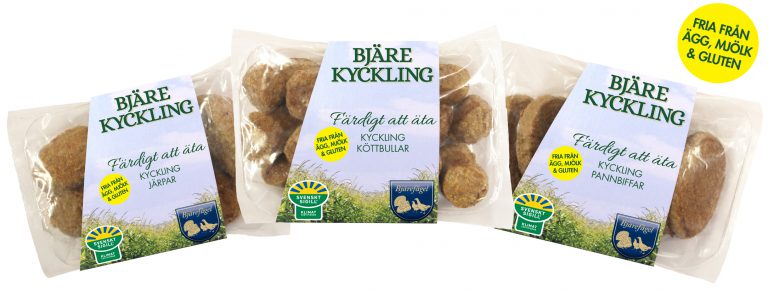
We often get asked why we don't Krav-certify Bjärekyckling and sell it as organic chicken. But is it better for the animals or the most ecologically sustainable?
– We brought in a consultant six or seven years ago to discuss the possibilities of switching to organic farming. It’s always good to challenge yourself and find out more. But the consultant confirmed what we already believed. There are many reasons why we shouldn’t be KRAV-certified, says Per-Olof Ingemarsson, founder and CEO of Bjärefågel.
Do not want to use fishmeal
Bjärekycklingar eat an entirely vegetable GMO-free diet based on corn grown in southern Sweden and locally grown cereals. The diet also includes legumes, grass, soy, vitamins, minerals and amino acids. The latter is not allowed in organic farming.
– If we raised organic chicken, we would therefore need to use fishmeal in the starter feed so that the birds would get all the nutrients they need and be healthy. That contributes to overfishing of the oceans, and that is not what we want. If we had organic chicken, we would probably also have to import organic feed, which we also do not think is sustainable.
Today, Bjärefågel imports certified soy from South America because the birds need a feed with a high protein content. Swedish-grown soy is not available.
– In the coming years, we hope to remove soy from the feed, but unfortunately we are not quite there yet. We cannot make a change without ensuring that it works all the way through. The chickens need a good protein content and we must first and foremost ensure that the birds are well cared for.
Often wet autumn and winter
The Swedish climate is very diverse. With the exception of a few summer months and possible warm springs or autumns, the weather often changes between rain, wind, cold, and snow.
– When the chickens go outside in bad weather, their legs and feet get wet. This moisture would have to be brought into the stall bed where they would then lie down. The stall bed then becomes corrosive and damages the birds’ feet and legs, says Per-Olof.
One of the tools we use to monitor the well-being of the chickens is the foot score. For each flock, our veterinary assistants assess the feet of the chickens. A value of zero is the best result, while 200 points is a poor result. The foot score for our flocks is usually zero or close to zero.
– Today, our chickens have very nice feet. We want them to continue to have them. This year, so far, we have an average of less than 0.5 out of 200.
Avian influenza and other diseases
Outdoor living also brings with it major risks of various infections, such as campylobacter and salmonella, but also avian influenza.
– In recent years we have had avian flu in Sweden every year. During periods of avian flu, it is not allowed to let the chickens out, sometimes in different zones and sometimes throughout Sweden. The ban also applies to organic chickens, says Per-Olof and continues:
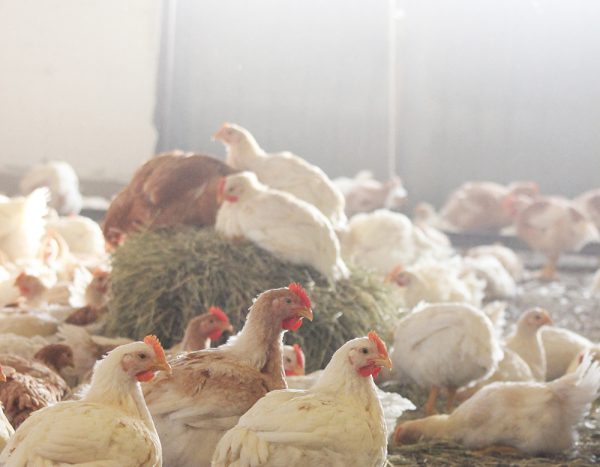
– We don’t want to put the chickens or our customers at risk. Instead, we have chosen to invest in a good indoor environment with almost twice as much space per bird, compared to what is required. We raise slowly growing Ranger Gold chickens that are very active and like to move around the entire barn. They have plenty of space to move around in.
Ventilation, air quality, temperature, water and feed are controlled via a computer. Should anything be wrong, staff are immediately alerted. We visit each barn twice a day to check on the chickens and the environment, to ensure that the birds are doing well.
– We are not organically certified, but we are ecologically sustainable. In addition, Bjärekyckling is the only chicken in Scandinavia that is climate certified through Svensk Sigill, says Per-Olof and smiles.